Water Leaking from the Boiler: Causes, Urgency and What You Can Safely Do
A leaking boiler is usually a water problem rather than a gas one, but the two sit inside the same casing, which is why the safe response is narrower than people expect. Here is what each leak position means, which cases are urgent, and where the line sits.
Is a leaking boiler an emergency?
Usually not in the sense people fear, and occasionally very much so. Most boiler leaks are a water fault inside an appliance that also burns gas. The water and the gas are separate systems, and a dripping pump gasket is not a gas escape. What makes a boiler leak different from a leak anywhere else in the house is that it sits inside a sealed casing alongside electrical components and a combustion chamber, so a small amount of water in the wrong place has consequences a bucket under a pipe does not.
The useful question is not whether it is an emergency in general but which of three categories it falls into, because the correct response is different for each.
| What you are seeing | Likely meaning | How urgent |
|---|---|---|
| Smell of gas, or a carbon monoxide alarm sounding | Not a water problem at all | Immediate. Leave, ventilate, call the National Gas Emergency Service on 0800 111 999 |
| Water running into the boiler's electrical area, scorching, or tripping breakers | Water and electricity have met | Isolate electrically and stop using it. Do not restart it |
| Steady flow, a soaked floor, or water reaching a ceiling below | An active water leak in or near the appliance | Same day. Isolate and contain, then get an engineer out |
| Intermittent drip, small puddle, pressure falling slowly | A seal, a valve or an expansion fault | Prompt but not frantic. Book it, contain it, watch the gauge |
| Water at the outside end of a small plastic pipe | Often the pressure relief discharge, or condensate | Diagnose before acting. It may be the boiler protecting itself |
The situations that are genuinely urgent
Three things move a boiler leak into the act now category. A smell of gas, at any time, for any reason, is not a plumbing matter and should go straight to the National Gas Emergency Service on 0800 111 999. A carbon monoxide alarm sounding is the same category. And water tracking into electrical components, whether in the boiler or in the fabric around it, is an electrical hazard before it is a water one, which is the subject of water leaks and electrical safety.
Everything else is a water fault that needs attention soon rather than instantly. The damage a slow boiler leak does is cumulative: corrosion of the case and components, a steadily depressurising system, and repeated automatic top ups that dilute the corrosion inhibitor and draw fresh oxygenated water in.
Where the water is actually coming from
Position tells you a great deal before anyone opens anything. A boiler is a small box with a lot in it, and water rarely travels far inside before it appears.
| Where the water appears | What it usually points at | What follows |
|---|---|---|
| Directly below the pipework beneath the boiler | A compression joint, an isolation valve, or the filling loop connection | Often the simplest case, and outside the sealed casing |
| From the body of the appliance onto the floor | Pump head gasket, auto air vent, diverter valve, or a heat exchanger seal | Internal work, so a registered engineer with the casing off |
| A small pipe discharging outside the building | The pressure relief valve has lifted or is passing | The valve is a symptom. The cause is usually expansion related |
| A plastic pipe running to a drain or gully | Condensate, which is normal, unless the pipe has split or blocked | Confirm it is condensate before treating it as a fault |
| Staining down the wall behind the boiler | Pipework in the wall, not the appliance | The boiler may be blameless entirely |
| Rusty or discoloured water | System water that has been in contact with steel for a long time | Points at corrosion and inhibitor loss rather than a new fault |
That last row is worth pausing on. Clean water suggests the mains side or a recently refilled system. Dark, rust coloured water is heating system water, and its colour is telling you about the condition of the whole system rather than about the leak. BS 7593, the code of practice for domestic central heating water treatment, treats loss of system water as a trigger to re-dose inhibitor, precisely because the protection leaves with the water.
The expansion vessel and the relief valve: the most common pair
If a boiler is dripping outside from a small pipe and losing pressure inside, the two facts are almost always the same fault. Understanding the mechanism saves a wasted call out.
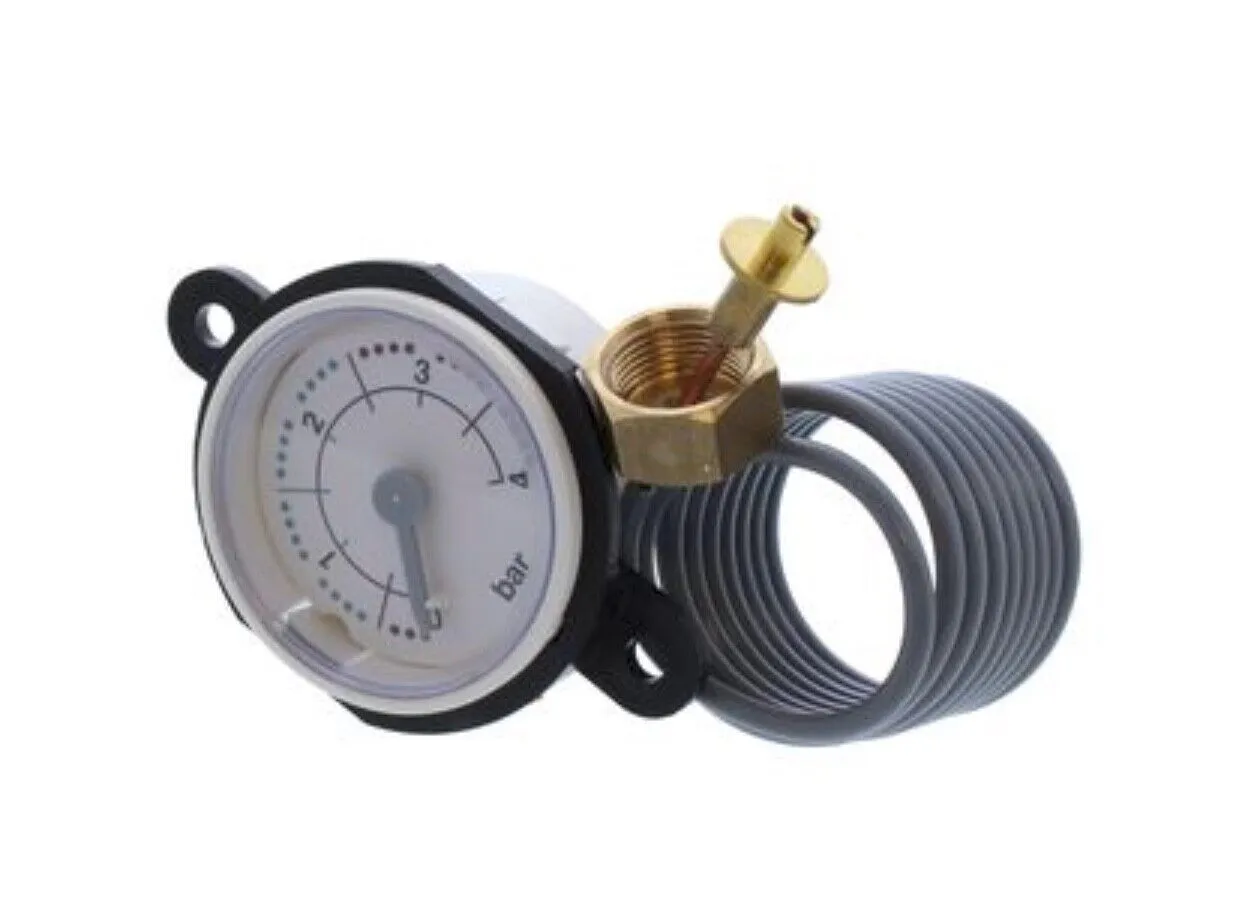
A sealed heating system holds a fixed volume of water. Water expands when heated, and the expansion vessel absorbs that expansion into a cushion of gas behind a diaphragm. If the vessel loses its charge, or the diaphragm fails, there is nowhere for the expansion to go. Pressure climbs sharply as the system heats, reaches the setting of the pressure relief valve, and the valve does its job by discharging water outside. The system then has less water in it than it started with, so when everything cools, pressure reads low.
The signature that identifies it
Watch the gauge through a full heating cycle rather than glancing at it once. A healthy sealed system moves modestly between cold and hot. The expansion fault signature is a large swing: normal or low when cold, climbing steeply toward the relief valve setting when hot, then sitting lower than before once it cools again. Repeated top ups that hold for a few days and then fall away point the same direction.
Re-pressurising in that situation treats the symptom and slowly makes things worse, because every top up brings fresh oxygenated water into a system designed to be sealed. Our guides to a boiler losing pressure and to repressurising a boiler cover the correct use of the filling loop, and the case where no leak can be found at all deals with exactly this scenario.
Condensate, and the water that is not a leak
Modern condensing boilers produce liquid water as a by-product of recovering heat from the flue gases, and that is the point of them. That condensate is mildly acidic and is drained away through a plastic pipe to a drain, a gully or an internal waste. A boiler producing condensate is a boiler working correctly, so the first question about any plastic pipe with water in it is whether it is doing what it was designed to do.
BS 6798, which covers the installation and servicing of gas-fired boilers up to 70 kW net input, sets out how condensate disposal should be arranged. Two failures are common. The pipe can split, usually where it has been run externally in a material or a size that was never suitable. And it can block, so condensate backs up and the boiler locks out to protect itself.
Why condensate faults cluster in cold weather
An external condensate pipe carries a slow trickle of water at low temperature, which is close to the worst case for freezing. A pipe that has worked for four years can freeze in a single cold snap, and the boiler will shut down rather than let condensate back up into itself. That produces a boiler that has stopped working in the coldest week of the year and, sometimes, water escaping from a joint that the ice has forced apart.
Manufacturer instructions cover thawing an external condensate pipe, and the sensible order is to read them for your specific boiler rather than apply a general method. What matters here is recognising the pattern: a boiler that fails on a freezing morning, with water around it, is far more likely to have a condensate problem than a heat exchanger one.
What you can safely do, and where the line is
There is a narrow set of actions that are sensible and safe for anyone, and a much larger set that is not.
- Turn the heating off at the programmer or thermostat, so the system is not cycling hot while it leaks.
- Isolate the electrical supply at the boiler's fused spur or switch, particularly if water is anywhere near electrical parts.
- Close the heating isolation valves on the flow and return pipes below the boiler, where they are fitted and accessible, to stop the system feeding the leak.
- Check the filling loop is properly closed. A loop left slightly open is a common reason a system appears to hold pressure while quietly taking mains water.
- Contain and protect. A container and towels, and moving anything valuable from below, buys time without risk.
- Photograph what you see before it is cleaned up, including the gauge reading, which is genuinely useful to whoever attends.
Beyond that, stop. The single most important line in this article is the next one.
What only a Gas Safe registered engineer may do
Under the Gas Safety (Installation and Use) Regulations 1998, work on gas appliances and fittings must be carried out by someone competent and registered, and Gas Safe Register is the official registration body for Great Britain. Removing a boiler casing is work on a gas appliance. That means the whole category of diagnosis that involves seeing inside the boiler, testing the expansion vessel charge, replacing a pump gasket, checking the relief valve, or inspecting a heat exchanger, sits with a registered engineer and nobody else.
This is not a formality. The casing of a room sealed appliance is part of the combustion seal, and an appliance reassembled by somebody without the training or the flue gas analyser to verify it is a carbon monoxide risk that nobody can see. Where our own work involves the appliance itself rather than the pipework around it, that part is carried out by a Gas Safe registered engineer. Our central heating leak detection work concentrates on the system beyond the boiler, which is where a great many so called boiler leaks actually turn out to be.
What looking at a boiler cannot tell you
A visual inspection, even a competent one, answers fewer questions than people expect, and knowing its limits prevents the wrong repair.
| Question | What looking can establish | What it cannot |
|---|---|---|
| Is the boiler the source? | Whether water is present at or under the appliance | Whether it originated there. Water tracks along pipes and joists and appears at the lowest point |
| Why is the relief valve discharging? | That it has lifted or is passing | Whether the cause is a failed vessel, a failed valve, or an over-filled system. That needs the charge tested |
| Is the heat exchanger cracked? | Very little from outside | A verdict. It usually requires the casing off and pressure testing by a registered engineer |
| Is the system losing water? | The gauge reading at one moment | The rate, or whether the loss is inside or outside the boiler. That needs logging over a full cycle |
| Is this leak new? | Whether the water is present now | How long it has run. Staining, corrosion and mineral deposits tell that story better than the water does |
The most consequential of these is the first. A boiler is often simply the lowest point in a run of pipework and the most visible object in the cupboard. A leak on a heating circuit under the floor several metres away can arrive at the boiler and look convincingly like a boiler fault. The way that gets settled is by isolating the appliance from the circuit and watching which side loses pressure, which is the same logic used when finding a central heating leak anywhere else in a property.
Repair, replace, and what drives the cost
Boiler leaks divide cleanly into three commercial outcomes, and it is usually obvious within the first hour which one applies.
- Pipework and fittings outside the casing. Compression joints, isolation valves, a filling loop. Straightforward work with readily available parts.
- Serviceable internal components. Pump gaskets, auto air vents, relief valves, expansion vessels and diverter valve cartridges are designed to be replaced, subject to parts availability for the model.
- The heat exchanger or the main body. This is where economics usually end the conversation, particularly on an older appliance where the part cost approaches the cost of a new boiler and the labour is substantial.
What drives cost is therefore not the size of the puddle. It is which of those three groups the fault sits in, whether the make and model still has parts support, and whether the leak has already damaged anything else. On an appliance beyond about a decade old with a failed primary component, the honest advice is often replacement rather than repair, and any firm that will not say so is not doing you a favour.
We confirm what is being charged before anyone travels, and a diagnosis on a boiler is quoted separately from any repair that follows it. What we will not do is give a figure for a component failure that has not yet been identified, because the range between a relief valve and a heat exchanger is too wide for a number to mean anything.
How we help with this
If the article describes a problem you actually have, these are the visits that deal with it.
- central heating leak detection
For a boiler losing pressure or a circuit that will not hold.
- our full guide to leak detection
How each method works and when it is the wrong tool for the job.
- leak detection in London
Finding a hidden leak without opening the property up first.
Frequently asked questions
Is a leaking boiler an emergency?
Sometimes, and the category matters. A smell of gas or a sounding carbon monoxide alarm is an immediate emergency and belongs with the National Gas Emergency Service on 0800 111 999, not a plumber. Water reaching electrical components, or a flow heavy enough to damage a ceiling below, is a same day problem. A slow drip with pressure falling gradually needs booking promptly and containing, but it does not need anyone woken up. Turn the heating off and isolate electrically while you decide.
Can I fix a boiler leak myself?
Only the parts outside the casing. You can turn the heating off, isolate the electrical supply at the fused spur, close accessible heating isolation valves under the boiler, check the filling loop is fully closed, and contain the water. Removing the casing is work on a gas appliance, which under the Gas Safety (Installation and Use) Regulations 1998 must be done by a Gas Safe registered engineer. That covers testing the expansion vessel, changing a pump gasket or inspecting the heat exchanger.
Why is water coming out of a pipe outside my house near the boiler?
It is usually one of two pipes. A pressure relief discharge means the safety valve has lifted because system pressure rose too high, most often because the expansion vessel has lost its charge. A condensate pipe carries the normal by-product of a condensing boiler to a drain and only becomes a fault if it splits or freezes. Identifying which pipe it is comes first, because one indicates a fault and the other indicates the boiler working as designed.
My boiler keeps losing pressure but I cannot see a leak. Where is it going?
Three places, in rough order of likelihood. Out through the pressure relief valve, which discharges outside and is easy to miss, usually because the expansion vessel has failed. Into the fabric of the building from a heating pipe under a floor or in a wall. Or nowhere at all, if a filling loop was left partly open and the gauge is being misread. Watching the gauge through a full heating cycle separates the first case from the others.
Is water leaking from a boiler dangerous?
The water itself is not, but where it goes can be. A boiler is an electrical appliance as well as a gas one, so water reaching the controls, the PCB or the supply is a genuine electrical hazard and the appliance should be isolated and left off. Water inside a room sealed appliance can also affect components you cannot see. If the casing is wet inside, or breakers trip, stop using it and have a Gas Safe registered engineer attend.
Should I repair or replace a leaking boiler?
It depends which component failed. Pipework, valves, pump gaskets, relief valves and expansion vessels are designed to be replaced and are normally worth repairing while parts remain available for the model. A failed heat exchanger or main body on an older appliance is usually where repair stops making sense, because the part cost approaches replacement and the labour is substantial. Age, parts support and what the leak has already damaged decide it, not the size of the puddle.