Ceiling Water Damage Repair Costs: What Actually Drives the Price
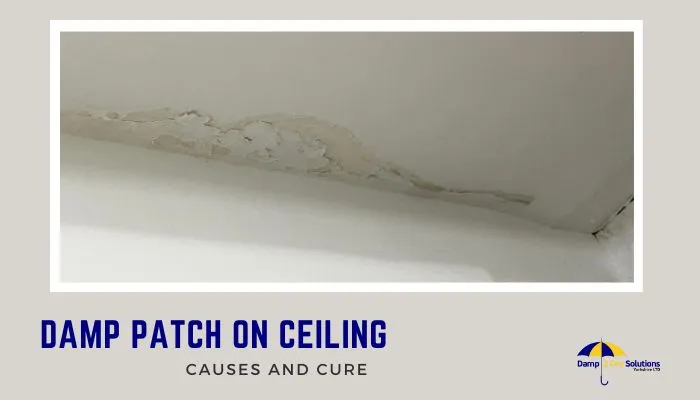
Two identical looking stains can differ by an order of magnitude in cost. The difference is never the stain. It is the construction above it, how far the water travelled, whether the ceiling has to come down, and whether the building is dry before anything is closed.
Why nobody can price a water damaged ceiling from a photograph
People ask this expecting a number and are usually frustrated by the answer. The frustration is reasonable, so it is worth explaining why the number does not exist rather than asserting that it does not.
A stain on a ceiling is the visible end of a process that happened somewhere else. The water came from a pipe, a fitting, a seal or a roof, travelled along a joist or through insulation, and emerged where the path ran out. The cost of putting that ceiling right depends almost entirely on things invisible from below: what the ceiling is made of, how far the saturation extends behind it, whether the timbers above took water, whether there is wiring in the affected zone, and whether the material can be dried in place or has to be removed. None of that reads from a photograph, and pricing from one means either a padded figure covering the worst case or a low one that gets revised upwards.
That is why the pages across this network show price on application rather than a rate card for ceiling repairs. A headline figure would be marketing rather than information, and it would be wrong for most of the properties that read it. What can be set out honestly is what the work consists of and what moves the cost. Our pricing page explains how we quote.
A water damaged ceiling is four jobs, not one
The most common reason a ceiling repair costs more than someone expected is that they were pricing one job and buying four. They are sequential, each has its own trade, and skipping any of them is what produces a repeat failure.
| Stage | What it involves | Who does it | What happens if it is skipped |
|---|---|---|---|
| 1. Find the source | Establishing which system is leaking and where, with instruments rather than inference | Leak detection engineer | The ceiling is repaired and stains again within weeks |
| 2. Stop it | Isolating, accessing and repairing the failed pipe, fitting or seal | Plumber or specialist repair | Nothing else in the sequence is worth doing |
| 3. Dry the structure | Removing saturated material, controlled drying, monitoring readings to a target | Drying contractor, or the occupier with equipment | Mould, distortion, and new plaster applied over wet substrate |
| 4. Reinstate | Patching or replacing the ceiling, skimming, priming, decorating | Plasterer and decorator | The visible part, and the only one most people were thinking about |
Two things follow. Quotes are only comparable if they cover the same stages, and many do not. And stage three is the one routinely dropped, because it is invisible, it takes time, and cutting it makes a quote look competitive. It is also the one that most reliably turns a single repair into two.
The detection is a separate line, and should be
There is a practical reason to keep finding the leak on its own line rather than bundled into a plumbing invoice, and it is not pedantry. Where a buildings policy includes a trace and access extension, that extension is written around finding the leak and the opening up and putting back required to reach it. An invoice reading "attended, fixed leak, repaired ceiling" gives a loss adjuster nothing to allocate. Three separate lines for detection, repair and reinstatement can be processed. Our step by step guide to a trace and access claim covers how that is handled.
The variables that actually move the price
What the ceiling is made of
This is the single biggest divider in London housing stock. A modern plasterboard ceiling is a sheet material on joists with a skim coat. When it gets wet, the board loses strength, the paper face delaminates, and the affected boards come down and are replaced. It is a bounded, predictable job.
Lath and plaster is a different proposition entirely. It is a lime or gypsum plaster pushed through gaps between thin timber laths so that it forms keys behind them, and those keys are what hold the ceiling up. Water softens the plaster and the keys, and the failure mode is that the plaster separates from the laths across an area much larger than the wet patch. Repairing it means either a matching lath and plaster repair, which is slow specialist work, or overboarding or replacing the section, which raises questions about the rest of the ceiling, about cornice and mouldings at the perimeter, and in a listed building or a conservation area about what is permissible at all. A Victorian conversion with an original ceiling and a run of decorative cornice is the case where the cost separates most sharply from the plasterboard equivalent.
Whether the ceiling can be patched or has to come down
The extent of what has to be removed is not decided by the size of the stain. It is decided by where the saturation actually reaches, by whether the board has lost integrity, by whether the ceiling is sagging or has separated from its fixings, and by the joint lines. Patching to the middle of a board produces a joint that will show, so a repair often runs to the nearest joists even where the wet area is smaller. Once more than a certain proportion of a room's ceiling is affected, taking the whole thing down and reboarding is both cheaper and gives a better finish than a patchwork of repairs.
How long the water ran, and where it went
Time is the multiplier that sits behind every other variable. A leak stopped quickly wets a limited area of board. The same leak left running saturates insulation, soaks joists, tracks along timber to somewhere else entirely, reaches wall plates and finds its way into a wall cavity or down to the floor below. At that point the ceiling is no longer the job. This is why the stains people live with for months are the expensive ones and the dramatic ones dealt with the same day frequently are not. Our article on what to do about a damp patch on a ceiling deals with the early stage.
Electrics in the affected area
Downlighters, a ceiling rose, a loft light, a junction box or cabling running through the zone all change the job. Water that has tracked into a fitting or an accessory means that circuit gets isolated and stays isolated until it has been inspected and tested by an electrician, and the cost is no longer a plastering cost. It also affects sequencing, because the electrician has to be there before the ceiling is closed, not after.
Access, and whose ceiling it is
In a flat, the ceiling below a leak is very often part of another leaseholder's demise. Opening it requires their permission and frequently the managing agent's too, which is a scheduling constraint rather than a materials one but it is a real cost in delay. The same applies to a ceiling over a stairwell, a high ceiling needing a tower rather than steps, or a room that has to be emptied and protected before work starts.
The age of the building
In a property built before 2000, textured ceiling coatings, some ceiling boards and older floor products may contain asbestos. Disturbing them is controlled work under the Control of Asbestos Regulations 2012, and some of it is licensable. The correct response to an unknown textured coating on a water damaged ceiling is to stop and arrange the right survey, not to take a bolster to it. That is a genuine cost driver and it is one people do not anticipate.
| Variable | Cheaper end | More expensive end |
|---|---|---|
| Ceiling construction | Modern plasterboard, flat, no mouldings | Lath and plaster with cornice, in a period or listed property |
| Extent | Localised patch within one board | Whole ceiling down and reboarded |
| Duration of the leak | Stopped the same day | Running unnoticed for weeks or months |
| What is above | Accessible void, nothing else wet | Saturated insulation, wet joists, water tracked into walls |
| Electrics | None in the affected area | Downlighters or wiring wet, circuit requiring inspection and testing |
| Drying | Dries naturally, monitored, no equipment needed | Sealed floor build up, trapped moisture, extended monitored drying |
| Access | Empty room, standard height, own property | Neighbour's demise, high ceiling, occupied room to be protected |
| Building age | Post 2000 construction | Textured coating of unknown composition needing a survey first |
Drying is the cost nobody budgets for
The instinct after a ceiling leak is to close it up and repaint, and it causes the most rework. Plaster applied over a substrate that is still wet does not bond properly, paint applied over damp plaster blisters and flakes, and moisture trapped inside a closed build up is what grows mould in a cavity where nobody can see it until it smells.
PAS 64, the code of practice for mitigation and recovery of water damaged buildings, is built around exactly this. It covers inspection, selection of drying techniques, estimating timescales and equipment, then monitoring and documenting the process, on the principle that a building is declared dry because readings say so. A contractor working to that will give you a moisture log with target readings. One who cannot say what readings they are working to is not drying the building, they are running a dehumidifier in it.
How long it takes depends on the material, the construction, how much water went in and how well the space ventilates, which is why an honest answer is a monitored process rather than a date. Our guide on drying out your home after a water leak covers what to ask for. The point for cost is that drying occupies time in which the room cannot be used and equipment is on hire, and that belongs in the budget from the start rather than arriving as a surprise in week two.
Where insurance changes the arithmetic
If the damage is an insured escape of water, the shape of the cost changes rather than disappearing. Several things happen at once.
- The excess applies. Escape of water carries a higher excess than most perils on many policies, and on a small ceiling repair the excess can be most of the job.
- The failed pipe is usually yours. The policy responds to the damage the water caused, not to the component that failed.
- Trace and access is capped. It covers finding the leak and opening up and putting back within a stated limit, and it generally requires that the escape has already damaged the building.
- Matching is a live issue. Insurers reinstate what was damaged. If the damaged ceiling is part of a decorative scheme running through several rooms, what gets paid for and what you choose to do to make it look right can be different things.
- Contractor choice affects the arithmetic. An insurer's own network contractor is priced against their schedule. Using your own usually means a cash settlement against that schedule rather than against your quote.
- Notification timing matters. Costs incurred before the insurer was told are the ones most often disputed, so make safe first and instruct reinstatement after.
The specific case: a shower upstairs leaking through the ceiling
This is the most common version of the problem and it has its own cost logic, because the ceiling is frequently the cheap half.
A shower leaking into a ceiling below has several possible sources and they differ enormously in what putting them right costs. Identifying which one it is, before anything is committed to, is the single decision that determines the total.
| Source | Scope of the fix above | Effect on the total |
|---|---|---|
| Perished silicone at the tray or screen edge | Rake out, clean, reseal | Minor. The ceiling is the main cost |
| Failed waste or trap seal under the tray | Access panel, replace the seal or waste | Minor, provided the tray can be reached |
| Cracked or flexing shower tray | Tray out, base corrected, tray replaced | Significant. Usually takes tiling with it |
| Failed tanking membrane behind the tiles | Tiles off, substrate checked, retanked, retiled | Substantial. Effectively a rebuild of the enclosure |
| Grout and substrate saturated over years | Strip back to sound material and rebuild | Substantial, and often reveals more once opened |
| Supply pipework in the floor or wall | Located, opened, repaired, tested | Varies entirely with access |
That identification is done by controlled testing rather than by looking. Each element is wetted in isolation with the others dry, and the ceiling below is monitored: the tray with the waste blanked, the waste alone, the screen and seal, the tiled walls, the supply pipework under pressure. It is the only way to avoid rebuilding a shower that was not the problem. Our article on a shower leaking through a ceiling sets out that sequence, and water leaking through a ceiling covers the immediate response.
What makes a cheap quote expensive
A low figure for a ceiling repair is usually low because of something it excludes rather than because of efficiency. The things to look for are consistent.
- No detection. A quote that starts at the plastering has assumed someone else found and fixed the leak. If nobody has, the ceiling will stain again.
- No drying stage, or no readings. Ask what target readings the work is being taken to and what happens if they are not reached.
- A patch where the board has lost integrity. Skimming over delaminated plasterboard produces a surface that fails from behind.
- No allowance for what is above. Saturated insulation left in place keeps the void wet long after the ceiling looks fine.
- Electrics not addressed. Wet fittings energised again without inspection, because the quote did not include an electrician.
- Nothing said about the textured coating. In a pre 2000 property that is a question that has to be answered before work starts, not during.
- One combined line. Impossible to compare against another quote, and impossible for an insurer to allocate.
The questions worth asking any contractor are narrow and they sort this out quickly. Has the source been found and by what method. What is the ceiling made of and how much of it is coming down. How will you know the structure is dry. Who is handling the electrics. And is the price broken into detection, repair, drying and reinstatement. A firm that answers those four clearly is giving you a figure that means something. A single number with none of that behind it is a guess wearing a quote's clothing.
How we help with this
If the article describes a problem you actually have, these are the visits that deal with it.
- how our pricing works
What sets the fee for a survey, and what is confirmed before we travel.
- our full guide to leak detection
How each method works and when it is the wrong tool for the job.
- damp and moisture surveys
Moisture mapping that separates a leak from condensation or damp.
Frequently asked questions
How much does it cost to repair a water damaged ceiling?
There is no single figure, and any quote given from a photograph is either padded or provisional. The cost depends on what the ceiling is made of, how far the saturation extends behind it, whether it can be patched or has to come down, whether wiring or fittings in the zone got wet, how long the structure takes to dry, and whether the building predates 2000 and the coating needs checking for asbestos first. We quote after seeing the actual construction.
Why does an upstairs shower leaking through a ceiling vary so much in cost?
Because the ceiling is often the cheaper half. A failed silicone seal or a perished waste seal is a contained repair. A cracked tray, a failed tanking membrane behind the tiles or grout that has been letting water into the substrate for years means the shower area comes out and is rebuilt, and the ceiling below becomes a line item. Which of those it is has to be established by testing each element in isolation before anything is committed to.
Is a lath and plaster ceiling more expensive to repair than plasterboard?
Generally yes, and often substantially. Plasterboard is a sheet material that is removed and replaced in bounded sections. Lath and plaster is held up by plaster keys formed between timber laths, and water softens those keys across an area larger than the visible wet patch, so the failure spreads. Repairing it means either slow specialist matching work or overboarding, and in a period property there are usually cornices and mouldings at the perimeter to deal with as well.
Do I have to dry the ceiling before repairing it?
Yes, and skipping it is the most common cause of a repair having to be done twice. Plaster applied over a wet substrate does not bond properly, paint over damp plaster blisters, and moisture sealed inside a closed build up grows mould where nobody can see it. PAS 64, the code of practice for mitigation and recovery of water damaged buildings, is built around monitoring and documenting drying to measured readings rather than judging by appearance.
Will my insurance pay for the ceiling repair?
If it is an insured escape of water, the damage to the ceiling normally falls within a buildings policy, subject to the excess, which is often higher for escape of water than for other perils. The failed pipe itself is usually not covered because it is treated as the cause rather than the damage. Finding the leak and opening up to reach it sits under a trace and access extension with its own limit, and that extension generally requires damage to have occurred already.
Should I get the ceiling repaired before the leak is found?
No. A ceiling repaired over an active leak stains again, and the second repair costs what the first one did. The correct order is find the source, stop it, dry the structure to measured readings, then reinstate. It is worth insisting that a quote separates those stages, both so you can compare it with another quote and so that an insurer can allocate each part to the right section of the policy rather than querying a single combined line.