Burst Pipe Insurance Claim UK: The First Hour, the Evidence and What Is Covered
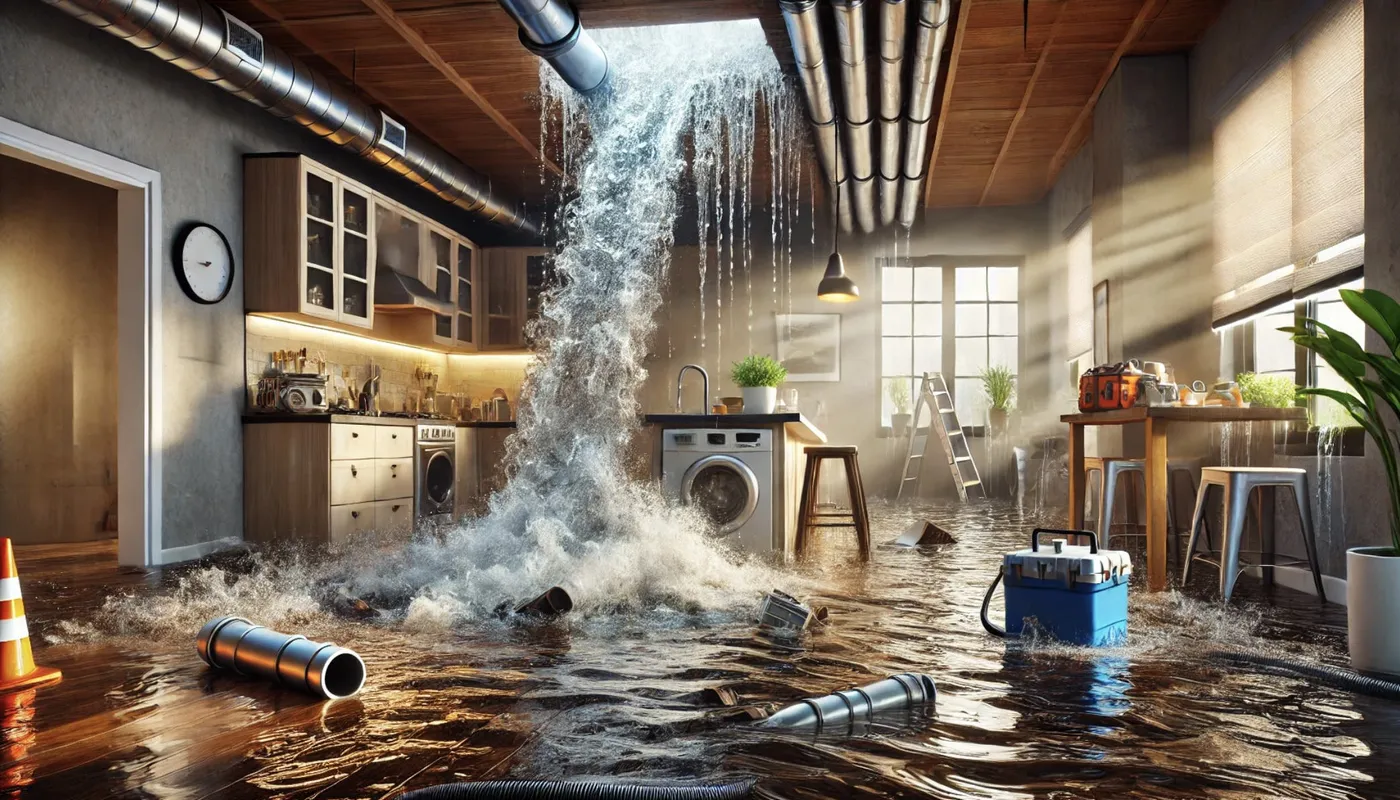
A burst pipe claim is decided by two things: what you did in the first hour, and whether the failure reads as sudden or gradual. Here is what a buildings policy covers, the evidence that settles it, and the escalation route if it is declined.
The first hour decides most of a burst pipe claim
An escape of water claim is not assessed on the pipe. It is assessed on the story the evidence tells about the pipe, and almost all of that evidence is created or destroyed in the first hour by people who are wet, cold and not thinking about loss adjusters. The order below protects both the building and the claim.
- Stop the water. Close the internal stop tap. If it will not turn, do not force it. Go to the external stop valve in the footpath, or in a flat, the isolating valve on the incoming supply inside the demise. Our guide on turning off the water at the stop tap in a London property covers where these actually live.
- Kill the power to anything wet. If water is near lighting, sockets or a consumer unit, isolate those circuits at the board and leave them isolated. It is the thing that stops a water incident becoming an injury.
- Drain down. Open the lowest taps on the affected circuit. A drained pipe stops feeding the leak even after the valve is closed.
- Photograph before you move anything. Wide shots of each affected room, then close shots of the failure point, the water path and the damaged contents. Time stamps come from the file metadata, so do not crop or re-save.
- Contain, do not clean. Lift what can be lifted, put buckets and towels down, open windows. Do not strip wet plaster or pull up flooring before anyone has seen it.
- Notify the insurer. Same day if possible, and certainly before you instruct anything beyond making safe.
That last point catches people out. Nearly every home policy contains a condition requiring you to notify a claim promptly and to take reasonable steps to prevent further loss. Making the property safe is expected of you. Commissioning a full strip out before the insurer has been told is a different matter, and costs incurred before notification are the ones most often argued about.
What not to throw away
The most valuable object in a burst pipe claim is the failed section of pipe. Keep it. If an engineer cuts a piece out, ask for it, label it with the date and location, and bag it. A split with clean bright metal at the edges tells a very different story from a pipe that is green, thin and pitted, and that difference is the one an insurer is assessing. The same applies to a failed flexible tap connector or appliance hose.
What a buildings policy actually covers when a pipe bursts
Standard UK household insurance handles a burst pipe under a peril usually called escape of water, sometimes worded as water escaping from fixed water tanks, apparatus or pipes. The peril is written around the consequences of water escaping, not around the component that failed, and that distinction explains most of the surprises.
| Item | Where it usually sits | Common qualification |
|---|---|---|
| Damage to floors, ceilings, walls and fitted kitchens | Buildings, escape of water | Subject to the policy excess, which is often higher for escape of water than for other perils |
| Damaged furniture, electricals, clothing, carpets that are not fitted | Contents, escape of water | Needs a contents policy; landlords letting a property frequently do not have one |
| Finding the source, and opening up and putting back to reach it | Trace and access extension | Usually capped, and generally requires that the escape has already damaged the building |
| The failed pipe itself | Usually not covered | Treated as the cause, not the damage. Repairing it is generally yours |
| Redecoration of the affected area | Buildings, often a separate sub-section | Frequently limited to matching the damaged area rather than whole rooms |
| Alternative accommodation | Buildings, separate section | Only where the property is genuinely uninhabitable, with its own limit |
Two qualifications sit behind almost every row. The first is the unoccupancy condition: most policies restrict or exclude escape of water cover once a property has been empty beyond a stated period, and many add a requirement to drain the system or maintain a minimum temperature over winter. The second is the excess, which is higher for escape of water than for most perils on a lot of policies. We set out the wider picture in our guide to whether home insurance covers water leaks in the UK.
Buildings and contents are two separate arguments
If the ceiling comes down onto a sofa, you are making two claims at once under two different sections, often with two excesses, and sometimes with two insurers if the building and the contents are covered separately. Keep the photographs and the inventories separate from the start. A single mixed list of plasterwork and furniture is a common reason a straightforward claim slows down.
Sudden failure and slow deterioration are treated very differently
This is the axis the whole claim turns on. A pipe that splits in a cold snap and floods a kitchen is a textbook insured event. A joint weeping into a floor void for two years, quietly rotting joists, is what most policies are written to exclude, through a wording about damage happening gradually or caused by wear, tear and deterioration.
The Financial Ombudsman Service publishes its approach to gradual damage complaints, and it is more nuanced than insurers sometimes present. Its guidance is that it may tell an insurer to pay where the damage was caused by an insured event such as escape of water, where the policyholder could not reasonably have been aware of the damage happening gradually, and where they claimed, or took reasonable action, as soon as they could reasonably have known. The Ombudsman also says the insurer must explain why it relied on the policy term to decline, and that it looks at the wording itself and at professional reports and photographs.
In practice the question is rarely "was the leak slow" in the abstract. It is "was there something the occupier saw, or should have seen, that a reasonable person would have acted on". That is why what you can show about the days before the failure matters as much as the failure itself.
| Situation | How it usually reads | What strengthens your position |
|---|---|---|
| Copper pipe splits along a seam after a freeze | Sudden, insured | The failed section retained, weather dates, no prior damp |
| Flexible tap connector bursts at the crimp | Sudden, insured | The failed hose kept, photographs of the cupboard before drying |
| Compression joint under a bath weeping for months | Gradual, contested | Evidence you had no access and no visible symptom until the ceiling stained |
| Pinhole corrosion in an old buried pipe | Argued both ways | An engineer's report distinguishing the failure point from the pipe's general condition |
| Rising water bill with no visible damage | Not yet a claim | Meter readings, a detection report, and a claim at the point damage appears |
Our article on telling whether a water leak is new or old goes through the physical markers that engineers and adjusters read: tide marks, staining rings, the colour and edge of a mineral deposit, timber condition and the state of any insulation.
Trace and access: what the extension is for, and what it is not
Trace and access is the part of a buildings policy that pays to find the leak and to open up and put back in order to reach it. Without it, the detection survey, the lifted floor and the reinstated ceiling are all yours. With it, they sit inside a stated limit rather than being unlimited.
The boundary people most often trip over is that trace and access generally responds to damage. The Ombudsman has upheld an insurer's refusal where a customer had a pressure drop and a suspected leak but no actual damage to the building, on the basis that an escape of water needs to have caused damage before the extension is engaged. A boiler quietly losing pressure with nothing wet to show for it is a maintenance problem, not a claim. Once water has reached plaster, a floor or a ceiling, the position changes.
The second boundary is that trace and access covers getting to the pipe and making good what was opened. It does not become a general refurbishment budget. If a floor has to come up in a strip to reach a joint, the extension is about that strip, not about relaying the whole room in a matching finish. Our step by step guide to a trace and access insurance claim sets out how to keep the paperwork in a shape the insurer can process, and our insurance leak claim work explains the reporting side.
Why the invoice needs to be split
One line reading "attended, found and fixed leak" is a common cause of a delayed settlement, because it gives the adjuster nothing to allocate. Ask for the work itemised into detection, repair and reinstatement, because those three sit in three different places in the policy: detection under trace and access, repair almost always on you, and reinstatement partly under each. An itemised invoice is what allows someone to say yes to the parts they can pay.
The evidence that settles a burst pipe claim
Assume nobody will see the property as it was. Everything the insurer knows about the first hour comes from you.
- The failed component, retained and labelled. Nothing else carries the same weight on the sudden versus gradual question.
- Photographs taken before mitigation. Wide, then medium, then close. Include the stop tap you closed and the meter if you have one.
- A short written timeline. When you first noticed anything, what you noticed, when the water was stopped, when you called whom. Written on the day.
- Meter readings. A reading at the time and, if you have them, earlier bills showing normal consumption. These separate a sudden burst from months of loss.
- A detection or engineer's report. The location of the failure, the method used to find it, the pipe material and the apparent mode of failure.
- Moisture readings if drying is involved. PAS 64, the code of practice for mitigation and recovery of water damaged buildings, is built around recording readings and monitoring drying rather than guessing when a wall is dry.
- Receipts for everything, including the emergency call out. Even where an item is not covered, it evidences the sequence.
Take the video as well as the photographs
If the damage is anything more than cosmetic, walk through the property with a phone camera running and narrate what you are looking at. Thirty seconds of that is worth a page of description, and it captures the things you would never think to photograph individually: the direction the water ran, what was standing in it, the state of the room before anyone moved anything.
Where burst pipe claims commonly go wrong
| Mistake | What it costs you | Do this instead |
|---|---|---|
| Throwing away the failed pipe or hose | The strongest evidence of sudden failure | Bag it, label it with the date and location |
| Stripping out and redecorating before notifying | Costs incurred pre-notification are the most commonly disputed | Make safe, photograph, notify, then agree the scope |
| Accepting a single line invoice | The adjuster cannot allocate it to a policy section | Insist on detection, repair and reinstatement as separate lines |
| Leaving a property empty over winter without checking the wording | Unoccupancy conditions can remove escape of water cover entirely | Read the condition, drain down or heat as it requires, keep proof |
| Letting a drying contractor start with no readings | No record that the building actually reached a dry state | Ask for the moisture log and the target readings in writing |
There is one more, and it is a habit rather than a mistake. People tidy. The instinct to get the house back to normal is reasonable and it is also the thing that removes the evidence. Resist it for a few hours longer than feels comfortable.
Flats, neighbours and two policies pointing at each other
A burst in a flat is rarely one claim. Water travels down, so the damage is usually in somebody else's demise, and the building is often insured as a whole under a block policy while each leaseholder holds their own contents cover. That produces a familiar stand off: the downstairs leaseholder wants the upstairs one to pay, the upstairs one says it was an accident, and the block policy sits there with an excess nobody wants to trigger.
The legal position in most cases is that your neighbour is liable only if they were negligent, not simply because the water came from their flat. An old pipe that failed without warning is generally not negligence. Ignoring a known drip for six months may well be, which is why the gradual and sudden distinction keeps reappearing. Our guide on a leak damaging a neighbour's flat deals with the lease and liability side.
Practically, in a block: tell the managing agent the same day, ask which insurer holds the building policy and what the excess is, and get the leak located properly rather than argued about. A report saying where the water came from, in which pipe, on which side of which wall, ends most of these disputes on the spot.
If the claim is declined or cut back
A decline is not the end of the process. Complain to the insurer in writing first, setting out what you disagree with and attaching the evidence. Under the complaint handling rules a firm has up to eight weeks to give you a final response. If you are unhappy with it, or none arrives in that time, you can refer the complaint to the Financial Ombudsman Service, generally within six months of the final response letter. The service is free for consumers and its decisions bind the firm if you accept them.
What moves these cases is technical evidence rather than a stronger argument. If the insurer's position is that the damage was gradual, an independent report describing the failure mode, the condition of the pipe at the failure point, and what was and was not visible from inside the property is what engages the Ombudsman's own test. Photographs of the failed section, meter data showing normal consumption up to the day of the burst, and a clear timeline do more than correspondence.
And keep the pipe. Otherwise winnable complaints fail because the only physical evidence went into a skip on the first afternoon.
How we help with this
If the article describes a problem you actually have, these are the visits that deal with it.
- insurance leak claims
What escape of water cover pays for, and what it does not.
- trace and access surveys
The survey and written report an insurer or loss adjuster asks for.
- burst pipe repair
A split or burst pipe isolated and repaired, day or night.
Frequently asked questions
Does building insurance cover burst pipes?
A buildings policy normally covers the damage a burst pipe causes, under the peril usually called escape of water, so soaked ceilings, floors, walls and fitted kitchens are generally within cover subject to the excess. What it does not usually cover is the pipe itself, because the pipe is treated as the cause rather than the damage. Finding the leak and opening up to reach it sits under a separate trace and access extension with its own limit, and unoccupancy conditions can restrict escape of water cover on an empty property.
How do I make a burst water pipe insurance claim?
Stop the water, isolate any electrics near it, photograph everything before you move or clean anything, then notify your insurer the same day if you can. Keep the failed section of pipe or hose, because it is the best evidence that the failure was sudden. Take a meter reading, write a short timeline of when you first noticed the problem and what you did, and ask any engineer for an itemised invoice separating detection, repair and reinstatement rather than one combined line.
Why do insurers refuse claims for slow leaks?
Most policies exclude damage that happens gradually or through wear and deterioration, because insurance responds to sudden, unforeseen events rather than maintenance. The Financial Ombudsman Service takes a more nuanced line: it may tell an insurer to pay where the damage came from an insured event, where you could not reasonably have known it was happening, and where you claimed as soon as you could reasonably have known. It also expects the insurer to justify relying on the exclusion and looks at professional reports and photographs.
Will my insurer pay to find the leak?
Only if your policy carries a trace and access extension, and generally only once the escape of water has actually damaged the building. The Ombudsman has upheld a refusal where there was a pressure drop and a suspected leak but no damage yet. Where the extension does apply, it typically covers the detection survey plus opening up and putting back what had to be removed to reach the pipe, within a stated limit, rather than a general allowance for redecorating the whole room.
Should I get the leak repaired before the insurer inspects?
Make the property safe immediately, because your policy requires you to prevent further loss, and nobody will criticise you for stopping the water and isolating wet circuits. What to avoid is a full strip out, replacement or redecoration before the insurer has been notified and has told you how they want to proceed. Costs incurred before notification are the ones most often disputed. Photograph thoroughly, keep the failed component, and agree the scope before anything beyond making safe is instructed.
What can I do if my burst pipe claim is turned down?
Complain to the insurer in writing first, setting out the decision you disagree with and attaching your evidence. The firm has up to eight weeks to issue a final response. If you are unhappy with it, or nothing arrives in that time, you can refer the complaint to the Financial Ombudsman Service, normally within six months of the final response. The service is free to consumers. An independent report describing the failure mode and the pipe's condition at the failure point tends to matter more than argument.