Thames Water Supply Pipe Leaks in London: The Boundary, the Rules and How the Leak Is Found
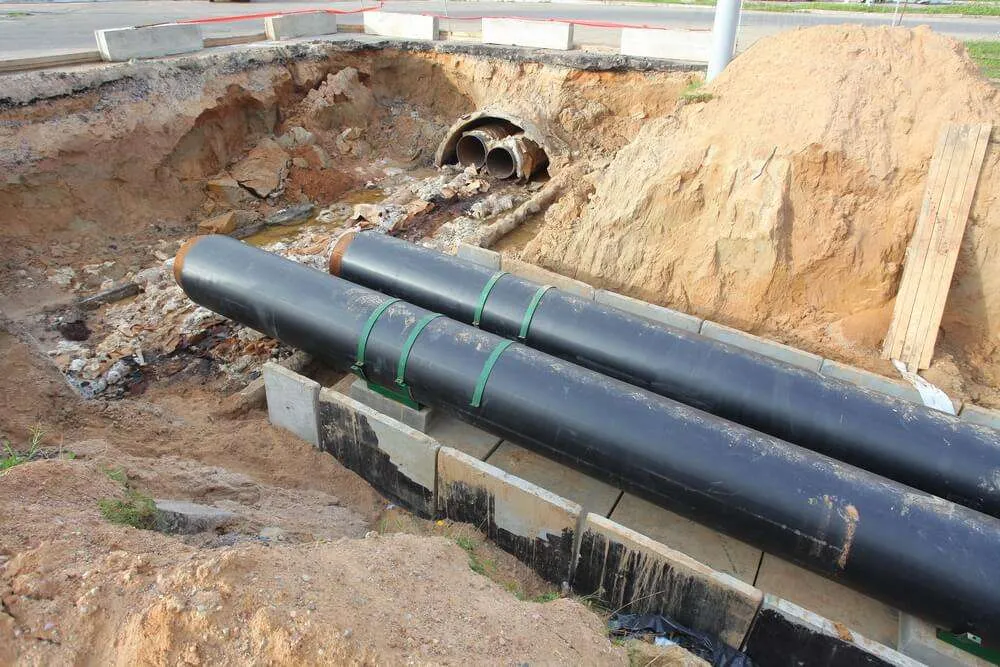
Most of the confusion about a supply pipe leak comes from one line on a map. Here is exactly where responsibility changes hands in the Thames Water region, what their published policy actually requires of you, and how a leak in a buried pipe is located.
Where Thames Water's pipe ends and yours begins
Almost every argument about a supply pipe leak comes down to a single boundary, and Thames Water's published position on it is clear enough to be worth quoting in substance.
Thames Water states that it is responsible for the water mains and for the communication pipe, which is the section linking your supply pipe to their mains. You are responsible for the water supply pipe that runs from the boundary of your property into your home, and they note that this pipe is usually under private land such as your garden or driveway. You are also responsible for all internal pipes, appliances and fittings, including toilets, taps, showers, water tanks and washing machines.
In practice the physical marker for that boundary is the external stop valve, usually in a small chamber under a cover in the footpath or just inside the property line. Everything on the street side is theirs. Everything on the house side is yours, including the run under your own front garden, path or drive, which is the part people are most surprised by.
| Asset | Where it runs | Whose responsibility |
|---|---|---|
| Water main | Under the street | Thames Water |
| Communication pipe | From the main to the boundary, linking to your supply pipe | Thames Water |
| External stop valve chamber | Typically in the footpath at the boundary | Thames Water, and it is the practical dividing point |
| Supply pipe | From the boundary, under your garden or drive, into the building | You, as the property owner |
| Shared section of a supply pipe | One pipe serving several properties | Shared jointly between the properties it serves |
| Internal stop tap and everything after it | Inside the building | You |
Our article on who is responsible for a Thames Water leak covers the ownership question in more general terms.
The London complication: shared supply pipes
A great deal of London housing, particularly Victorian and Edwardian terraces and the conversions made from them, is fed by a single supply pipe that branches to serve several properties. Thames Water's published position is that where one supply serves multiple properties, you and your neighbours have joint responsibility for maintaining the shared part of the pipe and any associated costs.
That produces a specific and awkward situation: a leak on the shared section is a shared bill, but the meter that detects it is probably only in one property, the damage is probably only visible at one property, and the neighbours may not agree that the pipe is shared at all. The thing that resolves it is not an argument, it is a survey that establishes where the pipe actually runs, where it branches, and where the failure is relative to the branch. Until that is known, nobody can say whose length of pipe has failed.
What Thames Water does, and what it does not do
This is the point where expectations most often diverge from the published policy. Thames Water's guidance for leaks at home puts the responsibility on the property owner and points to two routes: arranging repair through home insurance if you are covered, or using an approved plumber or leak detection specialist. They note that if you have registered for financial support or priority services they may be able to help. There is no general free repair service for a leak on your own supply pipe.
There is also a duty on you with a deadline attached. Their pipe responsibility guidance states that once a leak on your property is confirmed, it is your legal responsibility to arrange repair within four weeks. If it is not repaired in that window, Thames Water can carry out the repair and charge you for it, under Section 75 of the Water Industry Act 1991, which is the statutory power water companies hold to prevent waste and contamination of water.
So the sequence that follows a confirmed supply pipe leak is: you report it, they confirm whose side it is on, and if it is yours the clock starts. That is worth knowing before you spend three weeks getting quotes. Our guide on how to report a leak to Thames Water covers the reporting process itself.
Ofwat, codes of practice and where the rules come from
Water companies do not invent these terms independently. Their codes of practice are approved by Ofwat, the economic regulator for water in England and Wales, and Ofwat's leakage reporting methodology requires companies to assess leakage on customers' supply pipes separately from losses on their own network. That is part of why they take an active interest in leaks that are not on their assets. The Consumer Council for Water, the statutory consumer body, publishes its own guidance on leak allowances and is where to go if you cannot resolve a dispute with the company directly.
Proving which side of the boundary the leak is on
Before the ownership rules matter, somebody has to establish that the loss is real and where it sits. The test that does this is free and is the most useful thing you can do before calling anyone.
- Turn everything off. Every tap, the washing machine, the dishwasher, the ice maker. Leave nothing cycling.
- Read the meter fully, including the small dials, which is where a slow loss shows up.
- Leave it overnight, then read it again. Movement means water is going somewhere.
- Now close the internal stop tap and repeat. With the house isolated, continuing movement is loss between the meter and that stop tap, which is the buried supply pipe.
- If the meter sits at the boundary, that loss is on the pipe under your own land, not on Thames Water's communication pipe.
Our guide on reading your water meter to check for a leak sets out how to interpret the dials. If the meter does not move at all with everything off, you are not looking at a pressurised leak, and the investigation should move to waste, drainage, roof or condensation.
| What you observe | Most likely location | Next step |
|---|---|---|
| Meter moves with all taps off, stops when the internal stop tap is closed | Internal pipework | Isolate circuits one at a time and pressure test |
| Meter still moves with the internal stop tap closed | Buried supply pipe on your land | External leak detection on the supply run |
| Wet or unusually green patch on a lawn or drive that never dries | Supply pipe, or drainage | Acoustic survey on the supply, dye or camera on the drainage |
| Water surfacing in the footpath outside the boundary | Thames Water's communication pipe or main | Report it to Thames Water |
| Low pressure at every outlet, no wet ground | Partial blockage, undersized or failing supply pipe | Flow and pressure testing at the stop tap |
| Neighbours also affected | Shared supply pipe, or a mains issue | Establish the shared run before anyone excavates |
How a buried supply pipe leak is actually located
A supply pipe leak is one of the harder detection problems, because the pipe is under material you cannot see through, at a depth you may not know, on a route that may not be where anyone assumes. The work happens in three stages.
Tracing the route first
Before anything is listened to, the run has to be established. On a metal pipe that means a pipe locator, energising the pipe and tracing the signal along the ground. On plastic, which has no conductive path, a traceable sonde or a signal applied through an accessible fitting is used instead. This stage is not optional and it is the one most often skipped. Listening along a route the pipe does not follow produces nothing, and the pipe frequently does not take the straight line everyone assumes.
Acoustic work on the run
Water escaping from a pressurised pipe generates noise at the defect. A ground microphone is moved along the traced route in a grid, listening for the peak. Where two accessible contact points exist, a correlator is used: sensors are clamped at each end and the instrument calculates the source position from the difference in arrival time of the leak noise, using the distance between them and the speed of sound in that material. That calculation depends on the operator entering the correct material, diameter and length, which is another reason the route survey comes first.
Tracer gas to close the last stretch
Where acoustic work narrows the leak to a few metres but will not close it, the supply is drained and capped and charged with a tracer gas, typically five per cent hydrogen in nitrogen, which is non toxic and non flammable at that concentration. Hydrogen escapes through defects that barely weep water and rises through soil, hardcore and paving to the surface, where a sensitive detector finds it. On a plastic supply pipe under a driveway this is very often the method that produces the final answer.
What defeats each method on a supply pipe
| Method | Works well when | Defeated by |
|---|---|---|
| Pipe and cable locator | Metal pipe, or plastic with an accessible entry for a sonde | No access point, congested services, deep pipe |
| Ground microphone | Metal pipe, firm surface, quiet conditions | MDPE and other plastics damping the signal, loose or deep ground, traffic noise |
| Correlator | Two accessible contact points, known material and length | Only one accessible fitting, mixed materials along the run, unknown length |
| Tracer gas | Pipe can be drained, capped and charged; surface allows gas through | Sealed resin or membrane surfaces, a pipe that cannot be isolated |
| Excavation on a hunch | Never a method | Everything. It is how drives get dug up twice |
Our page on underground water leak detection in London covers the equipment and approach in more detail, and our article on a water leak in a garden or driveway deals with the symptoms that bring people to it.
Repairing a supply pipe, or replacing it
Once located, there is a genuine decision to make. Repairing a single defect in an otherwise sound pipe is straightforward. Repairing one defect in a pipe that is old, undersized, lead or already patched in several places is a poor use of an excavation, because the next failure is likely close behind and the cost was mostly in getting to the pipe rather than in the fitting.
Full replacement is usually done in modern MDPE, and on many properties it can be pulled through without a continuous trench by moling or bursting the old line, which matters when the route runs under a block paved drive. Anything installed on the supply must be suitable for contact with wholesome water under the Water Supply (Water Fittings) Regulations 1999, which a WRAS approved fitting demonstrates. That rules out the improvised repair, however tempting it looks in a hole in the rain.
Lead deserves its own note. Lead supply pipes are still common in older London stock. They are soft, they deform under a repair clamp rather than sealing, and patching leaves lead in contact with drinking water. Where a leak is found on lead, replacing the section or the whole run is generally the right answer, and it is worth asking Thames Water what their current position is on the communication pipe side before committing to work on yours.
The leak allowance: what it covers and the deadlines
A leak on your supply pipe registers on your meter, so a slow loss can run up a bill long before anything is visible. Thames Water operates a leak allowance for metered customers, and its published terms carry two separate deadlines that people miss.
| Requirement | Thames Water's published position |
|---|---|
| Who it applies to | Metered customers with a leak on their property |
| Deadline to repair | Within four weeks of being notified, or of the leak being identified |
| Deadline to claim | Within three months of the repair date, even before a bill arrives |
| How it is calculated | Comparing your usage in a similar past period against metered usage during the leak, and crediting the difference |
| Where there is no usage history | Based on typical use for a similar sized property |
| Evidence required | A plumber's details and invoice, or a Thames Water job number if they carried out the repair |
| If the leak is not repaired | Thames Water can repair it and charge you, under Section 75 of the Water Industry Act 1991 |
Two consequences follow. Keep the invoice and make sure it names the property, the date and the work done, because that is the evidence. And do not sit on the claim waiting for a bill: the three month window runs from the repair. Our article on the Thames Water leak allowance and a high bill covers the application. Terms differ between water companies, so outside the Thames Water region, check that company's own code of practice rather than assuming these figures apply.
Where supply pipe jobs commonly go wrong
- Digging before tracing. The assumed route between the stop valve and the house is frequently not the actual route. Excavating on that assumption is how a drive gets opened twice.
- Assuming the wet patch is above the leak. Water follows the path of least resistance through hardcore, along the pipe trench, or along another service, and surfaces where it can. The visible water is often metres from the defect.
- Treating a neighbour's shared pipe as their problem. A shared run is shared responsibility, and establishing where it branches is the only thing that settles who pays for what.
- Missing the four week window. It is a published duty with a statutory backstop, and it also affects the leak allowance.
- Repairing a pipe that should be replaced. Most of the cost of a supply pipe job is the excavation, so patching a failing lead or heavily repaired pipe spends that money for a short reprieve.
- Using non approved fittings. The water fittings regulations apply to anything on the supply, and a WRAS approved fitting is how compliance is demonstrated.
- Not photographing the excavation. If there is an insurance element, or a dispute with a neighbour about a shared pipe, the open hole is the evidence and it exists for one afternoon.
The pattern behind all of those is the same. A supply pipe leak is cheap to find and expensive to guess at, because everything about it is under something. Establish the route, prove which side of the boundary it is on, locate the defect properly, and only then decide whether you are repairing a pipe or replacing one.
How we help with this
If the article describes a problem you actually have, these are the visits that deal with it.
- leak detection in London
Finding a hidden leak without opening the property up first.
- underground water leak detection
Supply pipe leaks under drives, gardens and pavements.
- our full guide to leak detection
How each method works and when it is the wrong tool for the job.
Frequently asked questions
Is Thames Water responsible for my supply pipe leak?
Not if it is on your side of the boundary. Thames Water's published position is that it is responsible for the water mains and the communication pipe linking your supply pipe to those mains, while you are responsible for the supply pipe running from the boundary of your property into your home, usually under your garden or driveway, plus all internal pipework and fittings. Where one supply pipe serves several properties, the shared section is a joint responsibility between those properties.
Will Thames Water repair a leak on my own pipe for free?
Their guidance for leaks at home points customers to two routes, arranging repair through home insurance if covered, or using an approved plumber or leak detection specialist, and notes that they may be able to help if you have registered for financial support or priority services. There is no general free repair of a customer's supply pipe. They do state that once a leak on your property is confirmed it is your legal responsibility to arrange repair within four weeks.
What happens if I do not repair a leak on my supply pipe?
Thames Water can carry out the repair and charge you for it, using Section 75 of the Water Industry Act 1991, the statutory power water companies hold to prevent waste and contamination of water. Their published position is that you have four weeks from the leak being confirmed or notified to arrange the repair. Missing that window also affects the leak allowance on your bill, since the allowance terms are tied to repairing within the same period.
How do I know whether the leak is on my pipe or theirs?
Do the meter isolation test. Turn off every tap and appliance, read the meter fully including the small dials, leave the property untouched overnight and read it again. Movement means water is escaping. Then close your internal stop tap and repeat. If the meter still moves with the house isolated, the loss is on the buried supply pipe between the meter and that stop tap, which is yours. Water surfacing in the footpath outside the boundary is generally theirs.
How is a leak in a buried supply pipe found without digging?
In three stages. First the pipe route is traced, with a pipe locator on metal or a sonde or applied signal on plastic, because the actual route is often not the straight line people assume. Then a ground microphone is worked along that route listening for the leak noise, or a correlator is used across two accessible contact points to calculate the position from the arrival time difference. Where that narrows but does not close it, tracer gas in the drained pipe finishes the job.
Can I claim a leak allowance on my Thames Water bill?
If you are metered, yes, within their published terms. The repair must be arranged within four weeks of the leak being notified or identified, and the claim made within three months of the repair date, even if no bill has arrived. The allowance is calculated by comparing your usage in a similar past period against what the meter recorded during the leak, and crediting the difference. You will need a plumber's details and invoice, or a Thames Water job number if they did the work.