The meter is the only instrument in the house that measures every drop entering it, which makes it the cheapest leak test available and the most frequently misread. Here is how to run it properly, and exactly what a positive result does and does not prove.
What the dials and digits actually mean
A domestic water meter in the UK measures volume in cubic metres, and one cubic metre is one thousand litres. Almost every misreading comes from not knowing which part of the display is which, so it is worth two minutes to establish that before running any test.
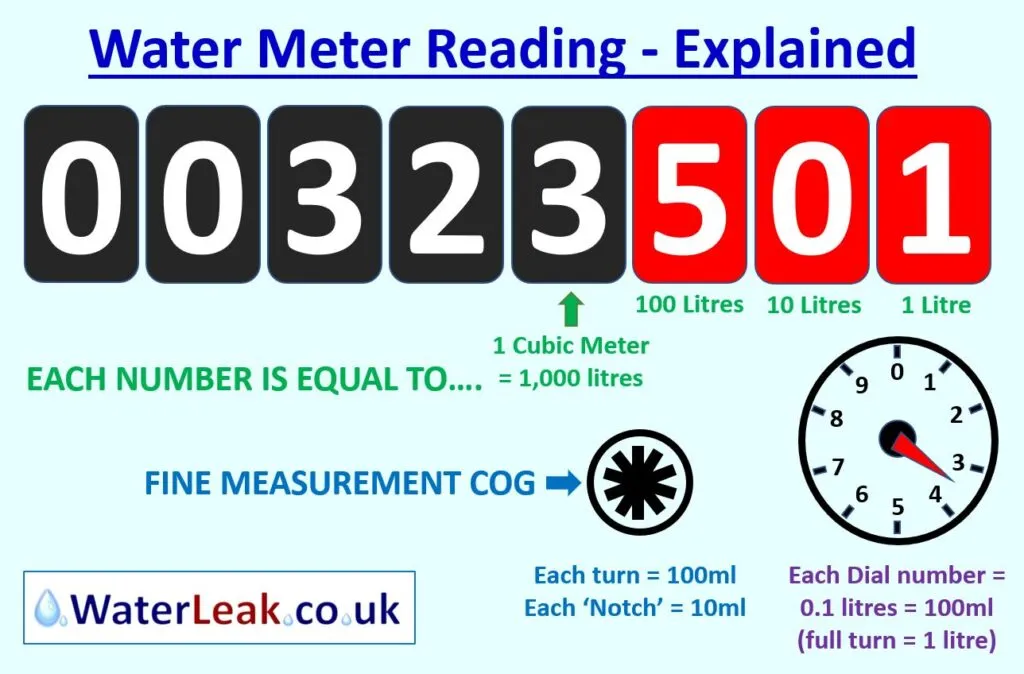
Black digits, red digits and the leak indicator
On a conventional mechanical meter, the black or white digits on the left count whole cubic metres, and that is the figure your bill is based on. The red digits, or a set of small red dials, count the fraction of a cubic metre: hundreds, tens and single litres. The red numbers are the useful ones for leak testing, because a small leak will move them long before it moves anything black.
Many meters also carry a leak indicator: a small triangle, star or asterisk that rotates whenever any water at all is passing. It is far more sensitive than the digits and it will turn on a flow too small to move the display in a reasonable time. If it is creeping round while nothing in the property is running, that is a finding on its own.
| What you see with everything off | What it means |
|---|---|
| Leak indicator perfectly still, red digits unchanged over an hour | No measurable flow. The cold supply is very likely sound |
| Leak indicator rotating steadily, red digits climbing | Continuous flow. Something is passing water constantly |
| Leak indicator creeping very slowly, digits barely moving | A small continuous loss. Real, but often a cistern rather than a pipe |
| Indicator moves in bursts with pauses | Something cycling: an appliance, a softener, a filling loop, or a neighbour on a shared supply |
| Digits move but the indicator does not | Read it again. Mechanical indicators can stick, and the digits are the record that counts |
Finding the meter, and what to do if you cannot
In London the meter is usually in one of three places. Outside, in a boundary box under a small plastic or metal lid set into the footpath, driveway or front garden near the property line. Inside, commonly under the kitchen sink, in a utility area, or in a hall cupboard near where the supply enters. Or, in a block of flats, in a communal riser cupboard or a bank of meters in a basement or plant room, in which case yours will be identified by a serial number your water company can give you.
An external box often holds water, silt or leaves over the face. The face can usually be cleared carefully with a turkey baster or similar, though if the chamber is full and will not clear, that is worth reporting rather than fighting, because a chamber full of water can itself indicate a leak on the communication pipe.
Smart and AMR meters change the workflow
If your supplier has fitted a smart or automatic meter reading device, the useful data is usually in your online account rather than on the meter face, and it is considerably better than anything you can do manually. Half hourly consumption data makes a continuous leak obvious: normal household use falls to nothing between roughly one and five in the morning, so a flat baseline that never reaches zero overnight is the clearest possible evidence of a continuous loss. Reading that pattern across a week beats a single spot test, and it costs nothing. A meter with unexpectedly high readings is worth interpreting carefully, which is covered in what to check when a smart meter shows high usage.
The overnight test, run properly
The principle is simple and the discipline is where people fail. Take a reading, use no water at all for a defined period, take a second reading. Any difference is water that left the supply without anyone using it.
- Turn everything off and keep it off. Taps, showers, washing machine, dishwasher, ice maker, water softener, garden irrigation and any water filter with an automatic flush.
- Do not use a toilet during the test. One flush invalidates it completely, so choose a window when nobody will.
- Photograph the meter face rather than writing the number down. Photographs carry a timestamp and they do not misremember a digit.
- Leave it at least two hours, ideally overnight. A slow leak needs time to accumulate a difference big enough to read.
- Photograph it again at the end, before anyone gets up and runs a tap.
- Repeat it once. A single test that disagrees with a second one usually means something was left running.
An overnight window is better than a daytime one for the same reason the smart meter data is better: it is the only period when household demand genuinely reaches zero, so anything the meter records is not you.
Turning the reading into litres a day
The raw difference is more useful once it is scaled, because the size of the loss says a great deal about what is producing it.
The arithmetic is straightforward. Subtract the first reading from the second to get the volume used, remembering that the red figures are litres and the black figures are thousands of litres. Divide by the number of hours the test ran, then multiply by twenty four. That gives litres per day, which is the number worth writing down and comparing against a repeat test later.
| Scale of loss | Commonly indicates | What it usually calls for |
|---|---|---|
| Nothing measurable overnight | No continuous loss on the cold supply | Look at heating, waste and rainwater instead |
| A small but consistent overnight loss | A cistern passing into the pan, a dripping tap, a weeping fitting | Check every toilet and tap first. This is the most common finding by a wide margin |
| A substantial continuous loss with nothing visible | A concealed pipe under a floor, in a wall or below ground | Detection work, because the water is going somewhere you cannot see |
| A large loss with no damp anywhere in the property | Frequently an underground supply pipe leaking into the ground | Establish the boundary and who owns the failed section |
| Loss that appears only at certain times | An appliance cycling, or a shared supply with another property | Identify the pattern before treating it as a leak |
That fourth row surprises people. A supply pipe leaking below ground can lose a great deal of water without producing a single damp patch indoors, because the water simply disperses into the soil. A high bill with a dry house is a classic signature, and it is one of the reasons an unexplained water bill is worth taking seriously even when nothing looks wrong.
What the meter test cannot tell you
A positive result is genuinely valuable, but it answers exactly one question. Being clear about the other four it does not answer prevents a lot of wasted effort.
| Question | Does the meter answer it? | Why |
|---|---|---|
| Is water leaving my cold supply? | Yes, definitively | Everything entering the property passes through it |
| Where is the leak? | No | It measures at one point. A loss could be anywhere from the boundary to the top floor |
| Is it a pipe, or a toilet? | No | A cistern passing into the pan reads identically to a failed pipe |
| Do I have a heating leak? | No | A sealed heating system is not fed continuously from the mains, so its losses never appear |
| Do I have a waste or drainage leak? | No | Waste water has already been metered on the way in |
| Is the leak on my side of the boundary? | Only partly | The meter position matters, and in shared supplies the picture is more complicated |
The heating exclusion is the one that catches most people out. A central heating circuit that is quietly losing water will keep dropping the boiler pressure while the meter reads perfectly still, because the system is only topped up occasionally through the filling loop. A still meter therefore does not mean you have no leak. It means you have no continuous cold supply leak, which is a narrower statement. Where the boiler gauge is falling, the investigation belongs with finding a central heating leak rather than here.
The mistakes that produce a false result
Four things account for most wrong answers. An automatic appliance running unnoticed during the test, most often a softener regenerating or an ice maker filling. A filling loop left partly open, which draws mains water into the heating system continuously. A shared supply pipe, which is common in Victorian conversions, where a neighbour's overnight use registers on a meter you assumed was only yours. And simply misreading which digits are litres and which are cubic metres, which turns a trivial loss into an apparent flood or the reverse.
Narrowing it down with the stopcock
Once a loss is confirmed, the meter can be used a second time to split the property in half, which is more useful than the first test.
Take a reading, close the internal stop tap, and take another reading after a couple of hours. If the meter continues to move with the internal supply isolated, the loss is upstream of that tap, which points at the supply pipe between the boundary and the house. If it stops, the loss is inside the property and downstream of the stop tap, and the search moves indoors.
That test depends entirely on a stop tap that closes fully, which in older London properties is not a given. A tap that is stiff, seized or weeping should not be forced, and what to do with a leaking or seized stopcock covers the alternatives. Where the internal tap will not close, the external boundary valve can often do the same job, though it needs a key and, on a shared supply, it affects the neighbours too.
The same splitting logic can be repeated indoors wherever there are service valves. Isolating the branch to a bathroom, a kitchen or an outside tap and re-reading the meter narrows the search a floor or a room at a time, and each valve that stops the movement removes everything downstream of it from consideration. This is slow but it is free, and it frequently reduces a whole house problem to a single run of pipe before any equipment is brought into the property.
One caution applies throughout. Every one of these tests assumes the meter serves your property alone. In parts of London a single supply pipe still feeds several houses, and where the meter sits on a shared section the readings include somebody else's overnight use. If the pattern looks like usage rather than a steady trickle, establishing what the meter is actually measuring comes before anything else.
What to do with a positive result
Three things follow, roughly in this order.
- Check the easy candidates first. Every toilet in the property, by wiping the back of the pan dry and watching for a trickle, or by looking for a ripple on the standing water. A passing flush valve is silent, invisible and a very common cause of a moving meter.
- Keep the evidence. Timestamped photographs of both readings, the dates, and a note of what was off. This is what a water company or an insurer will want later, and it is far more persuasive than a recollection.
- Establish the boundary. The pipe from the water main to the boundary stop tap belongs to your water company. The supply pipe from there into the building is the property owner's, including where it crosses somebody else's land. Thames Water publishes its pipe responsibility position, and confirming it early avoids paying for a repair that was never yours to make.
Leak allowances, and what they do and do not cover
Metered customers who repair a leak on their own supply pipe can often apply to their water company for an allowance against the water lost. This is a rebate on the volume, not a contribution to the repair, and the terms are set in each company's own published policy rather than by a single national rule. Thames Water, for example, sets out what it requires on its website, and in practice an invoice that states the address, the date of the repair, what was done and what the fault was will support an application far better than a receipt saying attended and fixed.
There is also usually an expectation that a confirmed leak on your side is repaired within a set period once identified. That is worth knowing, because the allowance and the obligation are two halves of the same policy. If the bill itself is the thing that prompted all this, checking a high water bill against a hidden leak sets out the sequence from bill to cause.
On our side, what drives the cost of finding a confirmed loss is access, whether the run is below ground, and which detection methods the pipe material and setting require. We confirm what is being charged before anyone travels, and the meter evidence you have already gathered genuinely shortens the job.
How we help with this
If the article describes a problem you actually have, these are the visits that deal with it.
- our full guide to leak detection
How each method works and when it is the wrong tool for the job.
- leak detection in London
Finding a hidden leak without opening the property up first.
- underground water leak detection
Supply pipe leaks under drives, gardens and pavements.
Frequently asked questions
How long should I leave the water off to test the meter?
At least two hours, and overnight is considerably better. A small leak needs time to accumulate a volume big enough to read reliably, and an overnight window is the only period when household demand genuinely reaches zero. Photograph the meter face at the start and again before anyone gets up, so the readings carry timestamps. Make sure no toilet is used during the test, because a single flush invalidates it entirely. Run it twice if the two results disagree.
What does the red triangle on my water meter mean?
It is the leak indicator, and it rotates whenever any water at all is passing through the meter. It is much more sensitive than the digits, so it will turn on a flow too small to move the display within a sensible time. With every tap, appliance and toilet in the property idle, a triangle that is creeping round means something is passing water continuously. That is a finding in itself, though it does not tell you whether the cause is a pipe or a cistern.
My meter is still but my boiler keeps losing pressure. Why?
Because a sealed central heating system is not fed continuously from the mains. It is filled once and topped up occasionally through the filling loop, so water escaping from a heating circuit never registers on the water meter. A still meter therefore only tells you there is no continuous loss on the cold supply. Where the boiler gauge falls steadily, the investigation belongs on the heating side: log the pressure across a full cycle with the filling loop isolated.
How do I convert my meter reading into litres per day?
Subtract the first reading from the second, remembering that the red digits count litres and the black digits count cubic metres, each of which is a thousand litres. That gives the volume lost during the test. Divide it by the number of hours the test ran, then multiply by twenty four to get litres per day. Write that number down, because comparing it with a repeat test later is how you tell whether a leak is stable or getting worse.
The meter is moving but I cannot find any damp. Is that possible?
Yes, and it is a recognisable pattern. A supply pipe leaking below ground can lose a great deal of water without producing any damp indoors, because the water disperses into the soil rather than into the building. A high bill in a dry house is a classic signature of exactly that. The other silent candidate is a toilet cistern passing into the pan, which sends water straight to the drain and leaves no trace anywhere in the property.
Can I get money back for water lost through a leak?
Often, if you are metered and the leak was on your own supply pipe. Water companies operate leak allowance schemes that rebate the volume of water lost, though the terms are set in each company's published policy rather than by a single national rule, and the allowance covers the water rather than the repair. Keep an invoice that states the address, the repair date, what was done and what the fault was, since a vague receipt is the usual reason an application stalls.