Swimming Pool Leak Detection Cost in London: Why It Is a Day, Not an Hour
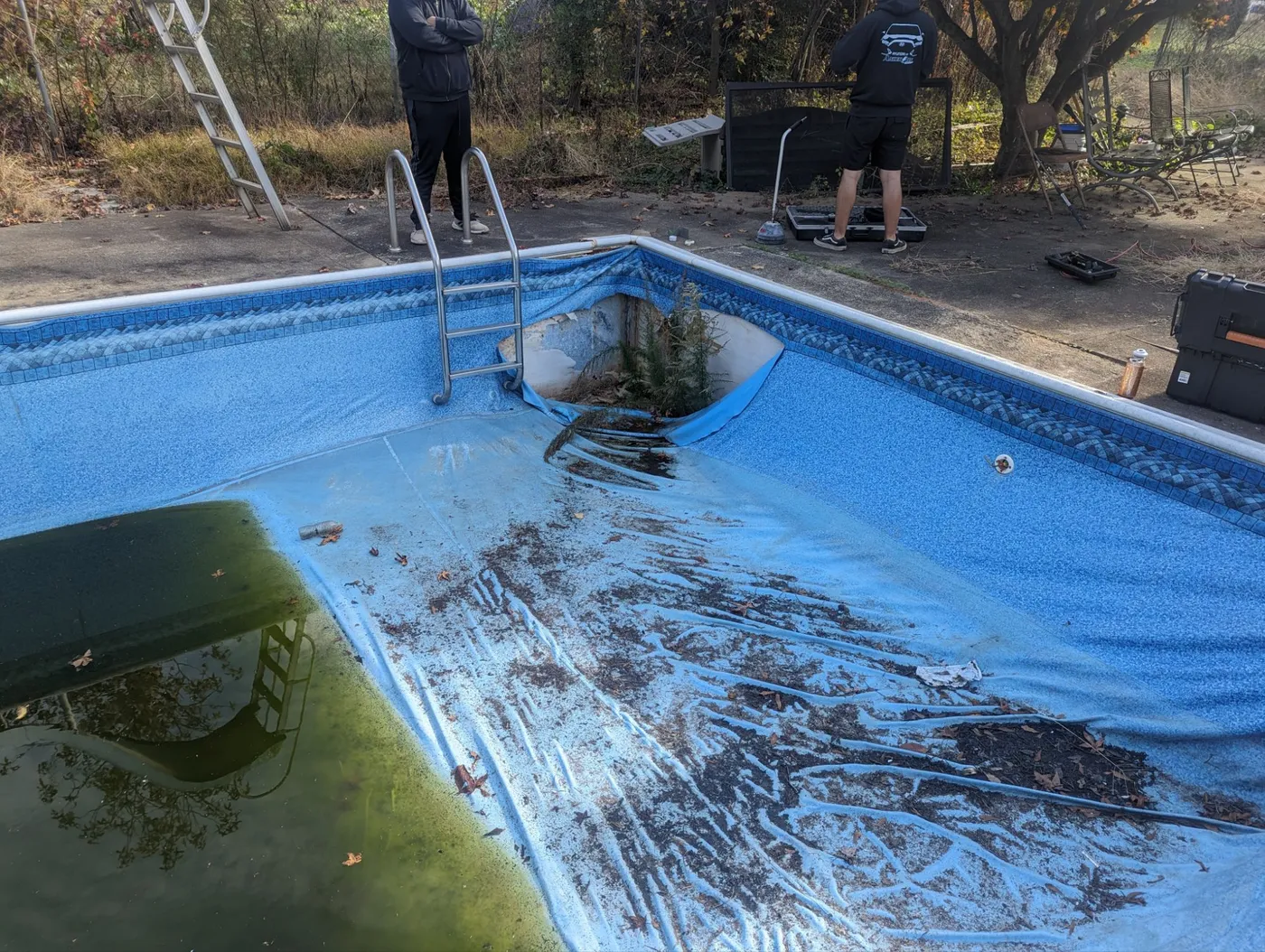
A pool survey is priced like a day because it is one. Here is the free test to run before you pay anybody, why two engineers is not padding, and why structure, liner and circulation pipework are three separate jobs at three separate costs.
Run the free test before you pay anybody
A pool that needs topping up is not automatically a pool with a leak, and the cheapest thing you can do about a suspected one costs nothing. Before any survey is booked, run a bucket test. It takes a bucket, a marker pen and twenty four hours of doing nothing, and it will either save you the price of a survey or give the engineer a head start worth a chunk of one.
The principle is simple. A bucket of pool water on the top step evaporates at broadly the same rate as the pool surface beside it, because both are the same water at the same temperature under the same air. What the bucket cannot do is leak. If the pool level drops further than the bucket level over the same period, the difference is not evaporation.
What a bucket test proves, and what it does not
It proves one thing cleanly: whether the pool is losing water beyond what the weather accounts for. That matters, because many suspected pool leaks turn out to be a hot dry week, a windy exposed garden or an uncovered pool in late summer. Evaporation from an open pool is larger than most owners expect, and wind speed drives it more than temperature does.
What it does not prove is where the water is going, which component has failed, or how big the loss is in absolute terms. It does not distinguish a structural crack from a failed light housing from a split return line. And it is thrown off completely by a handful of avoidable mistakes.
- Topping the pool up mid test. The comparison is between two falling levels, and refilling one of them ends it.
- Rain. It adds to both the pool and the bucket, but not equally, and it invalidates the day.
- An automatic filler left enabled. It quietly hides the entire loss you are trying to measure.
- A cover fitted halfway through. It changes evaporation on the pool and not in the bucket.
- A different pump schedule on day two. The test only compares like with like if the circulation is identical.
The full method, including the pump on and pump off comparison that follows it, is in our guide to confirming and finding a swimming pool leak. One refinement costs nothing and narrows the job considerably: run the test once with the circulation on and once with the pump off. A loss much worse with the pump running points at pressurised return pipework. A loss the same either way, or worse with the pump off, points at the shell, the liner or a fitting below the static line.
Why a pool survey is a day's work, and often two engineers
A domestic pipe survey is a matter of hours. A pool survey is a day, and not because pools are mysterious. A pool is several separate systems sharing one body of water, and each has to be eliminated in turn.
The sequence a day actually contains
The work has an order, and skipping steps is how surveys end inconclusive. It starts with establishing the static loss rate properly, which means letting the level find its own resting point rather than reading it once. Where a pool stops dropping tells you a great deal on its own: a level settling at the skimmer throat implicates the skimmer, one settling at the light points at the light housing, and one that keeps going below every fitting points at the shell or the main drain.
From there the circulation is isolated and each circuit tested separately, then the shell and its fittings examined, then whichever method suits what the first two stages implicated: dye testing at suspected points, acoustic listening on pressurised lines, tracer gas where a line runs under a deck, thermal imaging where a heated pool shows the escape as a temperature signature. Each is set up, run and packed down, and the set up is often longer than the test.
Then there is the waiting. Letting a level stabilise takes time you cannot compress, and pressure testing means bringing a circuit up, holding it and watching the gauge long enough that a slow loss becomes visible. An engineer standing beside a gauge is doing the job, not padding it.
Why a second engineer is not padding
Two engineers read like an upsell until you look at the geography. The plant room and the pool are rarely in the same place, and much of pool testing means changing something at one end while watching the result at the other. Valving a circuit, holding a line at pressure while dye is run at a fitting, isolating a return while somebody reads a gauge: all need a person in two places, and one engineer walking between them doubles the elapsed time.
There is also a safety dimension with a regulatory backdrop. The Health and Safety Executive's Health and safety in swimming pools sets the expectations for plant rooms, chemical handling and safe working around pool water. On a commercial or shared pool, lone working in a plant room is a poor idea and a second person is not optional.
The effect on cost is worth stating plainly: a pool survey is priced as a day of skilled attendance rather than an hourly visit, because that is what it is. Anyone offering to find a pool leak in an hour is offering to guess at it.
Structure, liner and circulation are three jobs at three costs
The most useful thing to understand before asking what a pool leak costs is that "pool leak" names three quite different problems with three repair paths and three price shapes. The survey tells you which one you have, and that is most of what you are paying it to do.
| Where it is leaking | Typical symptoms | How it is found | What the repair involves |
|---|---|---|---|
| Shell or structure | Level keeps falling below every fitting, loss unaffected by the pump | Static level, dye at cracks, sometimes tracer gas or acoustic | Crack repair or relining, usually with the pool drawn down |
| Liner and its seams | Loss steady, sometimes a visible wrinkle, ground soft in one spot | Dye testing, careful visual survey, sometimes a diver | Patch, seam weld, or replacement if the liner is at end of life |
| Fittings through the shell | Level settles at the depth of a light, skimmer or return | Static level, then dye at the specific fitting | Re-seal or replace the fitting, often a contained job |
| Circulation pipework | Loss much worse with the pump running, wet or sunken ground | Pressure testing per circuit, then acoustic or tracer gas | Excavation to the point, or a rerouted line if the run is poor |
| Plant room and equipment | Wet plant room floor, loss when filtering, backwash valve passing | Visual inspection under pressure, valve by valve | Seal, valve or pump repair, generally the least expensive outcome |
| Main drain and its line | Level falls past everything, sometimes silt movement | Isolating and pressure testing the drain line specifically | The hardest case, because access is under the pool floor |
The cost implication runs roughly down that table. A passing backwash valve is an afternoon. A light housing seal is contained and predictable. A split return line under a paved deck brings excavation and deck reinstatement into the picture. A structural crack or a main drain failure is the expensive end, because the pool comes down and the finish is involved.
That is also why a survey identifying the system but not the exact point is worth less than it sounds. Narrowing a leak to "somewhere in the returns" leaves the whole range above still open. A survey should end with a point, and a report naming which fitting, which circuit or which section of run.
What pressure testing the lines actually adds
Pressure testing converts a pool survey from an inspection into a diagnosis, and it is the step most often left out of a cheap quote. It works by isolating one circuit at a time, plugging it at the pool end, bringing it up to pressure at the plant room and watching whether it holds.
What it adds is elimination. A circuit that holds pressure is out of the investigation permanently, and on a pool with a skimmer line, two or three returns, a main drain and a cleaner line, eliminating four of six is most of the work. It is the only method that proves a buried line sound without digging it up, and it turns a vague suspicion about pipework into a specific line to chase acoustically or with tracer gas.
Isolating a circuit at the plant room
The reason this takes time is the valving. Older domestic installations frequently have no isolation on individual lines, so circuits have to be plugged and blanked by hand at both ends before anything can be pressurised. Manifolds are often unlabelled, buried behind later pipework, or arranged so two lines cannot be separated without cutting in a valve. None of that is complicated, and all of it is slow.
The test then needs holding time. A significant defect fails almost immediately, but the pinhole actually causing a slow loss over weeks may hold for several minutes before the gauge moves, which is why a rushed test returns a false pass and sends everyone back to the shell for no reason.
What moves the figure on a London pool
The variables that change what a survey costs are mostly about the property rather than the pool.
| Factor | Effect | What you can do about it |
|---|---|---|
| Indoor versus outdoor | Indoor pools add plant room complexity, humidity and access constraints | Give an accurate description when you book so the right kit is loaded |
| Number of circuits | Every additional return, cleaner line or feature adds a test cycle | Find the original installation drawings if they exist |
| Whether the plant is labelled and valved | Unlabelled manifolds with no isolation can absorb hours before testing starts | Photograph the plant room and send it in advance |
| Deck and surround construction | A paved or tiled deck makes excavation a reinstatement problem as well | Establish who will make good before anything is lifted |
| Access for equipment | Rear gardens reached through a house, or basement pools, mean carrying everything | Clear a route and arrange parking in advance |
| Whether the pool has been drawn down already | An empty pool removes the static level test, which is the most informative step | Do not empty it before the survey unless told to |
| Heated or unheated | A heated pool gives thermal imaging something to read | Keep the heating running as normal before the visit |
For an external benchmark on detection generally rather than pools specifically, Checkatrade publishes a UK water leak detection cost guide giving an average of around £162, a typical range of £115 to £234, and a full spread of £80 to £1,600 according to the techniques a job requires. Those are Checkatrade's national figures and they describe household detection, a shorter job than a pool survey. The useful part is the shape of that spread: scope, not rate, moves the number, and a pool sits at the upper end of the scope range rather than of a rate card. Why apparently identical jobs are quoted so differently is covered in why leak detection quotes differ across London.
Indoor pools, plant rooms and shared facilities
An indoor pool changes the survey in ways that are easy to underestimate. The shell is surrounded by a structure that shows water damage long before anyone suspects the pool, so damp in an adjoining room may be the first symptom rather than a falling level. Humidity control plant complicates thermal work, because a hot ventilation duct reads as convincingly on a camera as a leak does. And an indoor plant room is often a confined space with chemical dosing equipment in it.
On a shared or commercial pool there is a further layer. Water balance and circulation are managed to published standards, and the technical guidance maintained by the Pool Water Treatment Advisory Group is the reference operators work to. A pool losing water is losing treated, balanced, heated water and replacing it with cold untreated make up, so an unresolved leak shows up as a chemical and heating cost long before anyone does the arithmetic on the water. That is usually the argument that gets a commercial survey approved.
What to have ready, and what to ask
A pool survey goes faster and costs less when the engineer is not spending the first two hours discovering the installation.
- A completed bucket test, ideally run twice: once with the circulation on and once with it off.
- A record of the level over several days, marked on the tile line, with dates.
- Photographs of the plant room, including the manifold, the valves and any labelling.
- Installation drawings or as built information, however old, and the installer's name if known.
- The pump schedule, and whether an automatic filler is fitted and has been isolated during your testing.
- Clear access to the plant room, the pool surround and the meter, plus somewhere to park.
And the questions worth asking before you book, which say more about a firm than a price does.
| Question | What a good answer sounds like |
|---|---|
| Will you pressure test each circuit separately? | Yes, with the circuits named, and blanking arranged where there is no isolation |
| Is the survey priced as a day or by the hour? | A clear statement either way, with what happens if it overruns |
| Will one engineer attend or two? | An explanation tied to the testing, not a vague reassurance |
| What does the report contain? | A located point, the circuits eliminated, photographs, and the method used |
| What happens if the leak is not found? | The terms stated upfront, including what counts as a find |
| Who reinstates the deck if excavation is needed? | A direct answer, because it is frequently a separate trade |
That last pair matter most. Detection and repair being separate purchases is what keeps the diagnosis honest, and what makes a no find arrangement possible at all; the terms of ours are in no find, no fee leak detection explained. How we confirm the basis before anyone attends is on our pricing page, and the survey work itself sits under swimming pool leak detection in London.
How we help with this
If the article describes a problem you actually have, these are the visits that deal with it.
- swimming pool leak detection
Structure, liner and circulation tested separately.
- leak detection in London
Finding a hidden leak without opening the property up first.
- how our pricing works
What sets the fee for a survey, and what is confirmed before we travel.
Frequently asked questions
How long does a swimming pool leak survey take?
Usually a full day rather than a couple of hours. A pool is several systems sharing one body of water, and each has to be eliminated in turn: the static level established properly, each circulation circuit isolated and pressure tested, then the shell and its fittings examined with dye, acoustic listening or tracer gas as the earlier stages dictate. A good deal of that time is unavoidable waiting while a level stabilises or a gauge is held long enough for a slow loss to show.
Why do two engineers attend a pool leak survey?
Because the plant room and the pool are rarely in the same place and most pool testing means changing something at one end while watching the result at the other. Valving a circuit, holding a line at pressure while dye is run at a fitting, or isolating a return while somebody reads a gauge all need a person in two places at once. One engineer walking between them doubles the elapsed time and misses the moment the reading mattered. On commercial pools, lone working in a chemical plant room is also poor practice.
Should I do a bucket test before calling anyone?
Yes, and it costs nothing. A bucket of pool water on the top step loses water to evaporation at broadly the same rate as the pool beside it, but it cannot leak, so a pool level that drops further than the bucket over the same period is losing water somewhere. Run it twice if you can, once with the circulation running and once with the pump off and isolated, because a loss that is much worse with the pump on points at pressurised return pipework rather than the shell.
Does a bucket test tell me where the pool is leaking?
No. It proves only whether the pool is losing water beyond what evaporation accounts for, which is genuinely useful because a fair number of suspected leaks turn out to be a hot, dry or windy week. It cannot distinguish a structural crack from a failed light housing from a split return line, and it is easily invalidated by topping the pool up mid test, rain, an automatic filler left enabled, or a different pump schedule on the second day.
Why does the cost of fixing a pool leak vary so much?
Because pool leak names three different problems. A passing backwash valve in the plant room is the cheap end and is often an afternoon's work. A fitting through the shell, such as a light housing or a skimmer, is contained and fairly predictable. A split circulation line under a paved deck brings excavation and deck reinstatement into the job. A structural crack or a failed main drain line is the expensive end, because the pool has to come down and the finish is involved.
What should I avoid doing before a pool leak survey?
Do not empty the pool unless you have been asked to, because the static level test is the single most informative step and an empty pool removes it. Do not let anyone dig speculatively, because exploratory excavation destroys evidence and complicates access without narrowing anything. Leave an automatic filler isolated during your own testing so it does not mask the loss, keep the pump schedule as it normally runs, and photograph the plant room so the engineer is not discovering the installation on arrival.